

|
Who We are
Welcome to the Kituo Cha Sheria (KITUO) website. KITUO was established as a Non-Governmental Organization (NGO) in 1973 by a group of lawyers who recognized that inability to access justice occasioned by poverty, marginalization and vulnerability undermined fundamental human and peoples’ rights....Read more UN WOMEN LAND RIGHTS PROJECT Kituo cha Sheria under the Women land right awareness project has been carrying out a sustained advocacy effort for women right to land ownership in four target areas .i.e. Nyando, Kisauni, Taveta and Kapolet for the past 4 months. The project is informed by the fact that a significant number of women in Kenya do not own land; just approximately 1% of these women have land title deeds. This is corroborated by many research reports which again largely tend to blame the patriarchal nature of the society as the exacerbating factor to this sad land situation.
Various factors come into play to deny woman land ownership right, key among these being culture and tradition. Tradition/ custom has been singled out as the major factor pushing women at the societal margins as far as land ownership is concerned. Among many activities in Kenya, women at the societal margins as far as land ownership is concerned. Among many communities in Kenya, women are still considered property, and that a “property” cannot own property. Furthermore, lack of a clear land policy together with existence of many land laws, some of which are incompatible, has been responsible for complex land management and administration system in Kenya. This failure has resulted in several land related problems such as land grabbing, arbitrary disinheritance/dispossession of land property, environmental, social, economic and political problems since independence leading to immense suffering of many innocent citizens and especially women.
BULLA FOT CASE
The case is on a parcel of land in Garissa inhabited by the Fot clan. The population is about 3,000 people who have historically lived in a village known as Bulla Fot which is a Somali word for ‘The village of the Fot” The indigenous inhabitants of the larger Garissa district have never been issued with title documents to the parcel of land they have occupied since time immemorial.
Around 1963, there was a debate on whether persons living in North eastern Kenya should remain part of Kenya or secede to the Republic of Somalia. The Bula Fot was against the secession and this resulted to historical hatred of the members of the clan by the other Somali speaking people in and around Garissa.
Due to the hatred, the members of the Fot sub clan have suffered since independence. This combined with the general marginalization of the North Eastern Province, it has never had a single member from its midst acquire university education. It is a community that has suffered untold human rights violations and dispossession of their property.
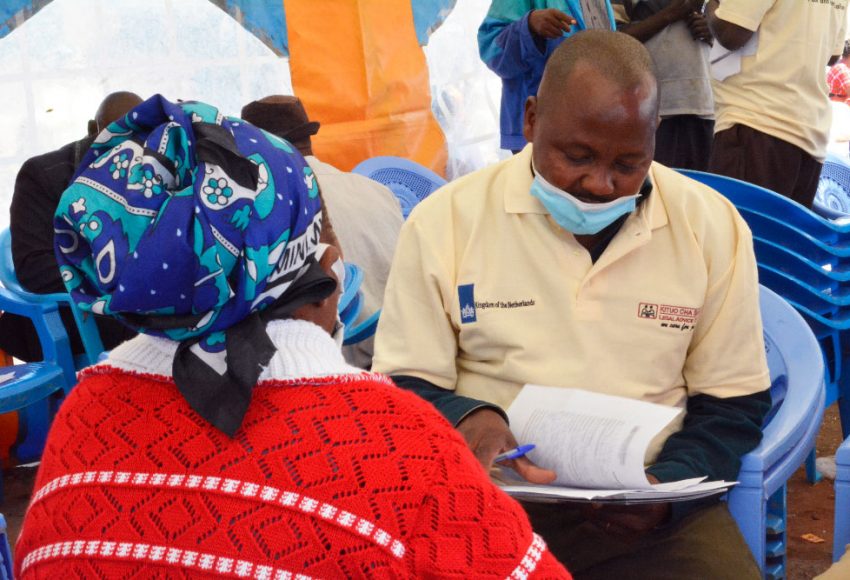
KITUO COMMUNITY LEGAL EMPOWERMENT PROJECT-UNDP AMKENI Under this project, Kituo Cha Sheria focuses on access to justice for all, especially the poor and marginalized in Kenya. To achieve this, Kituo Cha Sheria is raising citizens awareness on access to justice through PIL/group cases,organizing learning forums on access to justice,facilitating ffective citizen engagement and participation in the adoption and implementation of the legal aid bill/legal aid policy,employment and labour relations bill and land and environment bill and strengthening Alternative Dispute Resolution(ADR)mechanisms and referral systems.
NATIONAL PEACE POLICY ADVOCACY PROJECT-ACT Under this project,Kituo Cha Sheria is advocating for the adoption of a national policy framework for peace building and conflict management in Kenya.Kituo,in partnership with other CSO’s is creating awareness of this policy, promoting community ownership of the document as well engaging with Government in order to have a coordinated and all inclusive advocacy campaign.To get national support for this campaign,Kituo launched a signature campaign in support of this initiative.This signature campaign is ongoing |